

Benzoyl Chloride: Uses, Properties, Reactions and Safety
Home / Benzoyl Chloride: Uses, Properties, Reactions and Safety
What Is Benzoyl Chloride Uses Properties Reactions and Safety
Benzoyl chloride uses span across multiple industries including pharmaceuticals, dyes, and specialty chemicals. Benzoyl chloride (C6H5COCl) is a colorless organic liquid that serves as a vital chemical intermediate in modern manufacturing. This powerful acylating agent is highly reactive and transfers the benzoyl group to various nucleophiles, making it essential for creating complex organic compounds.
The importance of benzoyl chloride cannot be overstated in chemical synthesis. From pharmaceutical production to dye manufacturing, this compound plays a critical role in creating medicines, colorants, and specialty products that impact millions of people worldwide. Understanding benzoyl chloride uses helps manufacturers select the right intermediate for their synthesis needs.
Proper handling of benzoyl chloride requires knowledge of its properties, reactions, and safety protocols. This guide provides complete information about benzoyl chloride for professional chemists, pharmaceutical manufacturers, and chemical engineers working with this important compound in Ahmedabad and Gujarat.
What Exactly Is Benzoyl Chloride and Why Is It Important
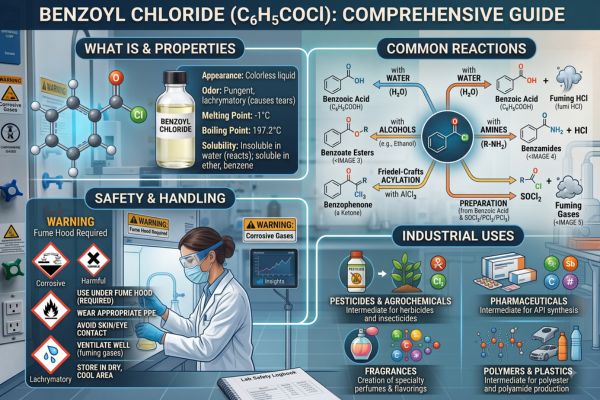
Benzoyl chloride is an organic compound that belongs to the acid chloride family. The molecular formula C6H5COCl represents a benzene ring attached to a carbonyl group with a chlorine atom. This colorless liquid has a pungent odor and boiling point of 197.2°C. The compound is highly reactive due to the polarized carbonyl carbon and easily displaced chlorine atom. Industries rely on benzoyl chloride as a chemical intermediate because of its exceptional reactivity. The compound participates in numerous synthesis reactions that would be difficult or impossible with less reactive reagents. From the pharmaceutical companies creating life-saving medications to dye manufacturers producing vibrant colorants, benzoyl chloride is indispensable.
Key Properties of Benzoyl Chloride
| Property | Value / Characteristic |
|---|---|
| Chemical Formula | C6H5COCl |
| Molecular Weight | 140.57 g/mol |
| Appearance | Colorless to pale yellow liquid |
| Boiling Point | 197.2°C |
| Density | ~1.21 g/cm³ |
| Melting Point | -1°C |
| Odor | Strong, pungent |
| Reactivity | Highly reactive with water and nucleophiles |
| Solubility | Soluble in organic solvents |
- Used as acylating agent in pharmaceutical synthesis
- Creates intermediates for industrial dyes and pigments
- Serves as precursor in fragrance and perfume industry
- Essential for fine chemical synthesis and research
- Acts as building block for specialty chemical production
Problem: Why Manufacturers Need Quality Benzoyl Chloride
Many chemical manufacturers face challenges when sourcing benzoyl chloride. Poor quality material leads to side reactions, lower yields, and wasted raw materials. Inconsistent purity creates batch-to-batch variations that compromise product quality. Chemical reactions using benzoyl chloride are sensitive to impurities. Water content causes unwanted hydrolysis reactions that reduce your desired product yield. Chloride impurities interfere with coupling reactions. Organic contaminants reduce selectivity and create byproducts that require expensive purification. Without reliable benzoyl chloride sourcing, pharmaceutical manufacturers cannot guarantee medication purity. Agrochemical producers struggle to meet regulatory standards. Fine chemical manufacturers cannot achieve the tight specifications their customers demand.
Solution: Best Practices for Using Benzoyl Chloride Effectively
The solution to benzoyl chloride challenges involves proper sourcing, storage, and handling. Start by selecting suppliers with proven quality certifications and consistent batch testing. Request certificates of analysis that verify purity levels above 99%. Proper storage protects your benzoyl chloride investment. Store in sealed glass or polyethylene containers away from moisture. Maintain cool, dry storage conditions and keep away from water, bases, and nucleophilic substances. Use sealed containers with inert atmosphere storage when possible. Implement proper laboratory practices for handling benzoyl chloride safely and effectively.
Best Practices:
- Work in well-ventilated areas or under fume hoods
- Wear chemical-resistant gloves and safety goggles always
- Use dry solvents and glassware for reactions
- Add benzoyl chloride slowly to nucleophile solutions
- Control reaction temperature to prevent side reactions
- Use proper stoichiometric ratios for optimal yields
- Maintain anhydrous conditions throughout synthesis
- Cool reaction mixtures before workup and purification
Common Benzoyl Chloride Uses Across Industries
Benzoyl chloride uses are remarkably diverse across the chemical industry. Pharmaceutical companies use benzoyl chloride for synthesizing antibiotics, anti-inflammatory drugs, antihistamines, and anticancer compounds. The pharmaceutical industry represents the largest consumer of benzoyl chloride globally.
Benzoyl Chloride Uses by Industry
| Industry | Specific Applications | Product Examples |
|---|---|---|
| Pharmaceutical | Drug synthesis, active ingredient creation | Penicillin derivatives, antibiotic compounds |
| Dye & Pigment | Dye intermediate creation, colorant synthesis | Azo dyes, anthraquinone pigments, reactive dyes |
| Fragrance & Perfume | Scent molecule precursor | Aromatic compounds, fragrance molecules |
| Specialty Chemicals | High-value compound production | Custom synthesis, research chemicals |
| Polymer Chemistry | Polymer modification, chain extension | Polyesters, polyamides, specialty polymers |
- Pharmaceutical: Creating active pharmaceutical ingredients for medications
- Dyes: Producing vibrant colorants for textiles and printing
- Perfumes: Generating aromatic precursor molecules
- Research: Laboratory synthesis and academic research
- Fine Chemicals: Manufacturing specialized high-purity compounds
Bezoyl Chloride Reactions Explainned
Understanding benzoyl chloride reactions helps chemists predict outcomes and optimize synthesis. The primary reaction mechanism involves nucleophilic acyl substitution. The nucleophile attacks the polarized carbonyl carbon, displacing chloride as the leaving group. Acylation is the most common benzoyl chloride reaction. The benzoyl group (C6H5CO-) transfers to electron-rich nucleophiles including amines, alcohols, and thiols. This creates amides, esters, and thioesters respectively. Friedel-Crafts acylation occurs when benzoyl chloride reacts with aromatic compounds. The aromatic ring nucleophilically attacks the carbonyl carbon, creating aromatic ketones. This reaction requires a Lewis acid catalyst like aluminum chloride. Hydrolysis happens when benzoyl chloride contacts water. The reaction produces benzoic acid and hydrochloric acid. While sometimes undesired, this reaction has industrial applications in producing benzoic acid.
Major Benzoyl Chloride Reaction Types
| Reaction Type | Nucleophile | Product Formed | Industrial Value |
|---|---|---|---|
| Acylation | Primary amine | Amide | Pharmaceuticals, dyes |
| Acylation | Alcohol | Ester | Cosmetics, plasticizers |
| Acylation | Thiol | Thioester | Protein labeling, research |
| Friedel-Crafts | Aromatic ring | Aromatic ketone | Dye intermediates |
| Hydrolysis | Water | Benzoic acid | Preservative production |
Safety Guidelines for Benzoyl Chloride Handling
Safety is paramount when working with benzoyl chloride. This corrosive chemical can cause severe skin burns, eye damage, and respiratory irritation. Never work with benzoyl chloride without proper personal protective equipment and training. Benzoyl chloride is classified as a hazardous chemical requiring careful handling, storage, and disposal. The compound reacts violently with water and bases, requiring anhydrous conditions. Improper handling can result in chemical burns, toxic gas release, and facility damage. Regulatory compliance is essential for facilities using benzoyl chloride. Maintain proper safety data sheets and follow all chemical safety regulations in your facility.
Safety Checklist:
- Always use safety goggles and chemical-resistant gloves
- Work only in well-ventilated areas or fume hoods
- Keep water and moisture away from benzoyl chloride
- Store in sealed containers in cool, dry location
- Have spill cleanup materials immediately available
- Know location of emergency eyewash and safety shower
- Report all spills and incidents immediately
- Maintain emergency contact numbers readily available
Frequently Asked Questions (FAQ)
What is benzoyl chloride used for in pharmaceuticals?
Benzoyl chloride serves as a crucial intermediate for synthesizing pharmaceutical compounds. It is used in the production of antibiotics, antihistamines, anti-inflammatory drugs, and anticancer medications. The compound’s high reactivity makes it ideal for creating amide bonds that are central to many drug molecules. Pharmaceutical manufacturers use benzoyl chloride to efficiently attach benzoyl groups to drug intermediates.
How should I store benzoyl chloride properly?
Store benzoyl chloride in sealed glass or polyethylene containers away from moisture and water. Maintain cool, dry storage conditions, ideally between 2-8°C. Keep containers away from bases, nucleophilic substances, and oxidizing agents. Ensure storage areas have good ventilation and are away from incompatible chemicals. Always use airtight containers to prevent moisture absorption and degradation.
What safety equipment is required when handling benzoyl chloride?
Essential safety equipment includes chemical-resistant gloves (nitrile or neoprene), safety goggles or face shield, and lab coat. Always work under a fume hood or in well-ventilated areas. Have emergency eyewash and safety shower facilities readily available. Maintain proper ventilation to protect against vapor inhalation. Keep spill cleanup materials and first-aid supplies nearby.
How does benzoyl chloride compare to other acylating agents?
Benzoyl chloride offers excellent reactivity and specificity for creating benzoyl derivatives. Compared to acetyl chloride, benzoyl chloride creates aromatic ketones through Friedel-Crafts reactions. Unlike anhydrides, acid chlorides like benzoyl chloride react rapidly at room temperature without catalysts in many cases. The choice depends on your specific synthesis needs and desired products.
What problems occur with low-quality benzoyl chloride?
Low-quality benzoyl chloride containing moisture leads to hydrolysis and reduced yields. Impurities interfere with nucleophilic acyl substitution reactions. Chloride salt impurities can slow down reactions or create unwanted side products. High water content causes loss of material through hydrolysis. Always source from reputable suppliers with quality certifications and batch testing.
Can benzoyl chloride be used in green chemistry applications?
Benzoyl chloride can be incorporated into green chemistry principles by minimizing waste and using catalytic systems. Researchers are developing more sustainable benzoylation methods with reduced solvent usage and improved atom economy. Coupling benzoyl chloride with milder nucleophiles and optimizing reaction conditions reduces byproduct formation. However, the inherent reactivity with moisture makes complete green substitution challenging.