

Succinimide CAS No. 123-56-8: Bulk Sourcing Guide for Industrial Buyers
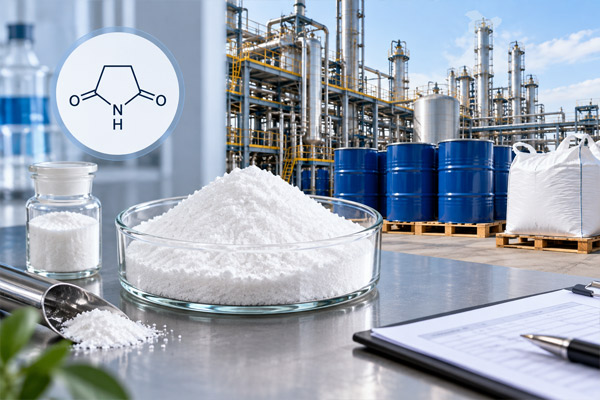
Sourcing Succinimide CAS No. 123-56-8 at Scale
Procuring Succinimide CAS No. 123-56-8 for large-scale industrial synthesis requires more than price comparison. Industrial buyers—pharmaceutical companies, fine chemical manufacturers, formulators and distributors—need suppliers who deliver consistent quality, complete regulatory documentation, reliable batch traceability and responsive technical support.
Succinimide CAS No. 123-56-8 is a cyclic organic compound used as an intermediate in industrial synthesis. Unlike retail or laboratory purchases, bulk sourcing involves contractual agreements, volume discounts, technical specifications, quality assurance protocols and supply chain reliability. This guide covers what industrial buyers should evaluate before placing orders.
Chemical Identification: Succinimide CAS No. 123-56-8
| Property | Details |
|---|---|
| Product Name | Succinimide |
| CAS Number | 123-56-8 |
| Molecular Formula | C₄H₅NO₂ |
| Molecular Weight | 99.09 g/mol |
| Appearance | White to off-white crystalline solid |
| Chemical Family | Cyclic imide (nitrogen heterocycle) |
This standardized identification ensures you receive the correct compound and can cross-reference it with regulatory and safety databases globally. Always confirm these parameters match your purchase order and the supplier’s Certificate of Analysis.
Industrial Role: Succinimide as a Chemical Intermediate
Succinimide CAS No. 123-56-8 functions as an intermediate in organic synthesis pathways. As a cyclic imide, it participates in reactions with nucleophiles, electrophiles and catalysts depending on process requirements. Buyers use Succinimide as a building block where its reactivity supports downstream transformations in multistep synthesis.
Industrial-grade Succinimide must meet strict purity thresholds, moisture limits and residual solvent specifications because trace impurities can reduce yield, introduce side reactions or complicate downstream purification. This is why bulk sourcing from qualified suppliers differs fundamentally from obtaining small laboratory quantities.
Applications: Verified Industrial Uses
Succinimide CAS No. 123-56-8 supports synthesis in fine chemical manufacturing, custom synthesis facilities and specialty chemical production. As an intermediate, it is consumed in reactions rather than used as an end product. Buyers should avoid suppliers making unsupported claims about pharmaceutical or agrochemical applications without third-party documentation.
When evaluating applications, request technical data sheets from your supplier showing:
- Reaction mechanisms where the compound participates
- Proven compatibility with common solvents and reagents
- Yield data or performance benchmarks from similar batch scales
- Shelf stability and storage conditions for your intended use
Laboratory-Grade vs. Industrial Bulk Sourcing: Key Differences
| Aspect | Laboratory Grade | Industrial Bulk Sourcing |
|---|---|---|
| Quantity | Grams to kilograms | Kilograms to metric tonnes |
| Purity | Often 95–99% | Typically 99%+ with tighter specifications |
| Lead Time | 1–4 weeks | 4–12 weeks, depending on volume |
| Pricing | Per gram or per kg; premium pricing | Volume-based; significant discounts at scale |
| Supplier Accountability | Limited batch documentation | Full traceability, CoA, SDS, batch certificates |
| Customization | Standard products only | Custom grades, packaging, particle size |
| Quality Assurance | Basic analytics | Comprehensive testing, stability data |
| Contract Terms | Purchase order per order | Annual agreements, supply commitments |
Bulk buyers negotiate contracts specifying price, delivery schedule, quality parameters,
and dispute resolution. This requires suppliers equipped for consistent production,
quality control, and regulatory compliance.
Quality Parameters and Specifications
Before placing a Succinimide order, confirm these specification categories with your supplier:
Identity and Purity:
- HPLC assay (typically 99%+ for industrial grades)
- Melting point range (should fall within recognized standards)
- Identity confirmation via FTIR or mass spectrometry
Impurity Limits:
- Residual solvents (pharmaceutical-grade suppliers test for Class 2 and Class 3 solvents)
- Water content / loss on drying (typically ≤1.0%)
- Heavy metals (especially for pharmaceutical intermediates)
- Related substances or by-products (HPLC quantification)
Physical Properties:
- Particle size distribution (relevant for downstream processing)
- Bulk density
- pH of aqueous suspension (if applicable)
- Appearance and odor confirmation
Microbiological (if required):
- Total aerobic microbial count
- Absence of specified pathogens (Salmonella, E. coli, etc.)
Request written specifications before order placement. Reputable suppliers provide target ranges and explain any batch-to-batch variation that falls within acceptable limits.
Certificates of Analysis, Safety Data Sheets and Documentation
A complete documentation package includes:
Certificate of Analysis (CoA):
- Batch/lot number and manufacturing date
- Test results for identity, purity, impurities
- HPLC chromatogram or spectra
- Analyst signature and laboratory accreditation stamps
- Expiration or retest date for stability
Safety Data Sheet (SDS):
- Hazard classification per GHS standards
- First-aid measures
- Safe handling and storage instructions
- Environmental disposal guidance
- Regulatory status in major markets
Batch Traceability:
- Raw material sourcing details
- Manufacturing process reference
- Quality control checkpoints during production
- Storage conditions and shelf life confirmation
Regulatory Compliance Certificates:
- ISO 9001 certification (quality management)
- DMF registration (if applicable for pharmaceutical use)
- FSSC 22000 or equivalent food safety certification (if relevant)
- Compliance with REACH, RoHS or other regional regulations
Documentation must accompany every shipment. Buyers should verify that certificates match the batch number on received materials and store copies for regulatory audits or product recalls.
Supplier Evaluation Checklist
Use this checklist when qualifying potential Succinimide suppliers:
- Manufacturing Capacity: Can they reliably supply your annual volume? Request recent production records.
- Quality Infrastructure: Do they operate accredited analytical labs? Request ISO 17025 accreditation or equivalent.
- Regulatory Certifications: ISO 9001, GMP compliance, pharmaceutical-grade status.
- Customer References: Ask for 3-5 industrial buyers in your sector. Call them directly about delivery performance and quality consistency.
- Pricing Transparency: Request itemized pricing (product, packaging, logistics) rather than opaque quotes.
- Lead Time & MOQ: Confirm minimum order quantities and realistic delivery timelines.
- Technical Support: Can they provide technical data, process troubleshooting or custom analytical testing?
- Documentation Standards: Do they provide complete CoAs, SDSs and batch traceability without delay?
- Supply Stability: Are they subject to raw material shortages or price volatility? How long have they been in business?
- Payment Terms: Do they offer credit terms for volume orders, or require prepayment?
- Dispute Resolution: What is their process for quality rejections or shipping damage?
Contact the supplier’s previous customers—this step often reveals issues price quotes and brochures will not.
The Role of Indian Fine Chemical Manufacturers and Exporters
India has established itself as a major producer of fine chemicals and pharmaceutical intermediates, including Succinimide. Indian manufacturers benefit from:
- Established Supply Chains: Decades of experience sourcing raw materials and managing international logistics.
- Regulatory Compliance: Many Indian producers operate to GMP, ISO 9001 and USFDA standards to serve global pharmaceutical markets.
- Cost Competitiveness: Efficient production enables competitive pricing for bulk volumes without compromising quality.
- Export Infrastructure: Direct access to shipping routes and experience with international documentation, customs and trade compliance.
- Technical Expertise: Specialized technical teams familiar with pharmaceutical intermediate synthesis and regulatory requirements.
Our facilities in Gujarat position us within India’s pharmaceutical and fine chemical hub, supporting reliable supply to pharmaceutical companies, chemical distributors and industrial formulators worldwide.
Building Your Succinimide Request for Quotation (RFQ)
When approaching suppliers, include these details to receive accurate, comparable quotes:
RFQ Information Checklist:
- Exact product name and CAS number (Succinimide CAS No. 123-56-8)
- Required purity grade (e.g., 99.0% min)
- Total annual or quarterly volume in kilograms or metric tonnes
- Analytical requirements beyond standard CoA
- Payment terms and currency preference
- Preferred packaging size and material
- Delivery destination and frequency (single shipment vs. scheduled deliveries)
- Required certifications (ISO 9001, GMP, pharmaceutical-grade, etc.)
- Timeline for first delivery
- Regulatory compliance needed in your jurisdiction(s)
Why Global Buyers Choose an Experienced Indian Acid Chloride Manufacturer
For decades, global chemical synthesis leaders have partnered with Indian fine chemical manufacturers to secure dependable intermediate supply. Companies like Shital Chemical Industries, founded in 1996 in Khambhat, Gujarat, exemplify the technological and operational strengths that make Indian manufacturers compelling partners.
Decades of Specialized Chlorination Chemistry: Handling elemental chlorine and thionyl chloride requires specialized engineering and scrubber installations. Established Indian producers have refined these operations over decades, transitioning reactions seamlessly from pilot scale to multi-ton commercial production.
Cleaner Synthesis via the Benzotrichloride Process: A major operational strength of Shital Chemical Industries is the proprietary manufacture of low-boiling acid chlorides using the Benzotrichloride process. Unlike conventional preparation routes that introduce sulfur or phosphorus impurities, the Benzotrichloride process generates products completely free of sulfur and phosphorus contaminants. This provides exceptional purity for demanding pharmaceutical and agrochemical syntheses.
Robust Quality and Regulatory Alignment: Operating under ISO 9001:2015 certified quality systems, reputable Indian exporters maintain advanced analytical testing facilities equipped with modern Gas Chromatography systems. Their manufacturing site in Khambhat, Gujarat, provides an ideal logistical base with immediate access to Gujarat’s integrated chemical ecosystem, specialized hazardous chemical transport fleets, and international container terminals.
Frequently Asked Questions
What is the minimum order quantity (MOQ) for bulk Succinimide
MOQs vary by supplier and production schedule. Industrial suppliers typically accept orders from 25 kg upward, with lower per-unit pricing at higher volumes (500 kg+). Confirm MOQ before preparing your RFQ to avoid wasted time on non-competitive suppliers.
How long does it take to deliver Succinimide CAS No. 123-56-8?
Standard lead time ranges from 4-8 weeks after order confirmation, depending on supplier production schedule, regulatory documentation and shipping distance. Rush orders may be available at premium pricing. Confirm lead time in your quotation request to align with your production schedule.
What certifications should a Succinimide supplier hold?
Look for ISO 9001 (quality management), pharmaceutical-grade certification, and GMP compliance if the compound will be used in drug manufacturing. Some buyers require DMF registration or USFDA inspection history. Request copies of certificates before signing supply agreements.
How do I verify the authenticity of a Succinimide shipment?
Verify batch number and manufacturing date on the Certificate of Analysis match the material received. Perform an identity test (melting point, FTIR, or HPLC) independently if your process is sensitive. Reputable suppliers expect and support such verification by customers.
Can I store Succinimide longer than the supplier's recommended shelf life?
Shelf life guidance assumes proper storage conditions (cool, dry, sealed). If your facility maintains these conditions, the material may remain stable beyond the stated date, but request a retest or stability data from your supplier to confirm. Use oldest material first (FIFO inventory management).
What should I do if a Succinimide batch fails quality specifications?
Contact your supplier immediately with the failed test results and batch number. Reputable suppliers investigate root cause, issue a credit or replacement, and document the incident. Establish dispute resolution procedures in your supply agreement before problems arise.
Conclusion
Selecting a reliable supplier for Succinimide CAS No. 123-56-8 requires careful evaluation of quality standards, regulatory compliance, technical support and supply chain stability. Industrial buyers benefit from detailed RFQs, thorough supplier qualification and comprehensive documentation covering identity, purity, impurities and batch traceability.
Shital Chemical Industries supplies Succinimide and other pharmaceutical intermediates and fine chemicals to industrial buyers globally. Our quality infrastructure, regulatory compliance and technical expertise support your sourcing requirements.