

Custom Synthesis vs Contract Manufacturing vs OEM Chemical Manufacturing in India
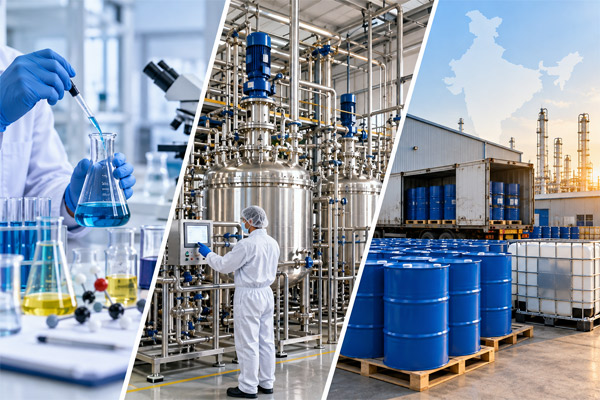
Choosing Your Chemical Manufacturing Partner
When your business needs to outsource chemical production, you face a critical choice. You might need to develop a new molecule, scale up a laboratory process to industrial volumes, manufacture an off-the-shelf chemical in bulk, or reduce production costs by transferring operations to a specialized facility. Each path requires a different manufacturing model.
A chemical contract manufacturing company in India offers three distinct services: custom synthesis for bespoke molecules and development batches, contract manufacturing for established processes scaled to commercial volumes, and OEM (original equipment manufacturer) production for standardized products. Understanding which model suits your project will save time, reduce costs and ensure your supplier is equipped to deliver what you need.
This guide explains the differences between these models, when to use each one, how a project progresses through development and commercial stages, and what questions to ask before committing to a manufacturing partnership.
Defining the Three Manufacturing Models
Custom Synthesis
Custom synthesis is the development and production of a compound tailored to your specifications. Your supplier performs laboratory-scale or small batch synthesis, refines the process, develops analytical methods, and delivers samples or pilot quantities. Custom synthesis is exploratory work where the process may not be optimized, and the supplier is problem-solving alongside you. This model is best for discovering new molecules, developing proprietary processes, or evaluating chemical feasibility before committing to larger-scale production.
Contract Manufacturing
Contract manufacturing (sometimes called toll manufacturing or outsourced manufacturing) means your supplier manufactures a chemical according to a process and specifications you provide or have jointly developed. You own the process know-how and intellectual property. Your supplier operates your established process at agreed scale, manages quality, maintains batch records, and delivers finished product meeting your specifications. Confidentiality and process control are built into the commercial agreement. Contract manufacturing is the right choice when you have a proven process and want to scale production without building internal capacity.
OEM Chemical Manufacturing
OEM manufacturing means your supplier manufactures and sells a standard chemical product under your label or to your specifications. You do not own the underlying process; your supplier manufactures a standardized compound using their proprietary know-how. You purchase the product at scale, often with volume discounts and flexible terms. This model suits businesses that need bulk supply of established chemicals but lack manufacturing capability or prefer to avoid the capital cost of building production facilities.
Comparison Table: Custom Synthesis vs Contract Manufacturing vs OEM
| Aspect | Custom Synthesis | Contract Manufacturing | OEM Manufacturing |
|---|---|---|---|
| Ownership of Process | Supplier develops process with your input; you may license it | You own the process; supplier executes it | Supplier owns and controls process |
| Product Specification | You define target properties; final specification may evolve | You define and control final specification | Supplier defines standard specification |
| Development Requirement | Significant development and optimization needed | Process is proven; scale-up may be required | No development; product is standardized |
| Production Scale | Small batches (grams to tens of kg) | Commercial scale (100s of kg to tonnes) | Commercial scale at supplier’s capacity |
| Confidentiality | Standard IP protections; process details shared | High confidentiality; your process is protected | Limited confidentiality; standard product |
| Raw Material Responsibility | Supplier sources materials to your specification | You supply materials or approve supplier sources | Supplier sources all materials |
| Quality Documentation | CoA, analytical data, process notes | Full batch records, CoA, SDS, traceability | Standard CoA and compliance documentation |
| Best-Suited Buyer | R&D teams, early-stage companies, formula developers | Established manufacturers scaling production | Commodity buyers, distributors, formulators |
When to Choose Custom Synthesis
Choose custom synthesis when:
- You are developing a novel compound or proprietary formulation and need a manufacturing partner to help establish viability.
- You have a laboratory procedure but lack industrial-scale production equipment or expertise.
- You need small batches (under 100 kg) for research, formulation development or pilot market testing.
- You want expert problem-solving from a supplier’s chemistry team during the development phase.
- Your project timeline allows for experimentation and optimization before committing to larger-scale production.
- You need process development support, including analytical method development and scale-up consultation.
Custom synthesis suppliers charge for time and materials. You should expect higher per-unit costs and longer timelines because the supplier is solving technical challenges specific to your molecule or process. However, you retain significant influence over how the compound is developed, and you may own the resulting process knowledge depending on your agreement.
When to Choose Chemical Contract Manufacturing
Choose chemical contract manufacturing when:
- You have an established process (proven in your lab or pilot scale) that you want to scale to commercial volumes.
- You want to maintain control over your process and intellectual property while outsourcing production.
- You need consistent, high-volume supply (typically 500 kg to several tonnes per batch) without investing in your own manufacturing facility.
- You require confidentiality and security around your proprietary chemistry or formulation.
- Your process requires specialized equipment, regulatory compliance (GMP, pharmaceutical-grade), or technical expertise your business does not have in-house.
- You want to reduce capital costs, operational overhead and time-to-market by partnering with an established manufacturer.
Contract manufacturing is the preferred model for businesses with proven chemistries that need to scale. Your supplier becomes an extension of your technical team, following your process specifications precisely, maintaining strict quality standards and protecting your intellectual property through confidentiality agreements. Pricing is typically fixed per unit or batch, making budgeting predictable.
When OEM Chemical Manufacturing is Appropriate
Choose OEM manufacturing when:
- You need bulk supply of an established, standardized chemical (fine chemical, pharmaceutical intermediate, specialty chemical).
- You do not have proprietary process know-how and do not need to protect a unique synthesis route.
- You want to reduce per-unit costs by buying standardized product in large volumes.
- Your business is formulation or distribution focused, not manufacturing focused.
- You prefer supplier flexibility on production schedules, batch sizes and delivery rather than maintaining a dedicated manufacturing contract.
OEM manufacturing is ideal for chemical distributors, formulators and businesses purchasing ingredients for broader products. Your supplier manages all production details; you purchase finished material and focus on your downstream application. OEM arrangements often include negotiable pricing, volume incentives and flexible ordering.
Project Stages: From Enquiry to Commercial Supply
Stage 1: Initial Enquiry
You contact your potential manufacturing partner with project details: the chemical name, CAS number (if applicable), target specification (purity, form, analytical parameters), desired quantity, current process status (if custom synthesis or contract manufacturing), and delivery timeline. The more information you provide at this stage, the faster your partner can assess feasibility.
Stage 2: Technical Feasibility Assessment
Your supplier's technical team reviews your request and determines whether they can deliver. For custom synthesis, they evaluate process complexity and timeline. For contract manufacturing, they assess whether their existing equipment and expertise match your process requirements. For OEM, they confirm they can supply the standard product at your required scale. Your supplier may ask clarifying questions about your end use, regulatory requirements, and quality expectations.
Stage 3: Confidentiality Discussion
Before sharing detailed process information, you and your supplier agree on confidentiality terms. For contract manufacturing, this typically involves a Non-Disclosure Agreement (NDA) protecting your process, formulation and commercial details. For custom synthesis and OEM, confidentiality protections may be simpler but should still be formally documented. Do not share sensitive information until confidentiality terms are agreed.
Stage 4: Sample or Development Batch
For custom synthesis, your supplier prepares a small batch following your specification or their proposed process, delivers samples, and provides analytical data (CoA, purity, testing results). You evaluate the material to confirm it meets your needs. For contract manufacturing, your supplier may run a trial batch using your process to confirm equipment compatibility and final quality. For OEM, your supplier provides standard samples confirming quality and performance.
Stage 5: Scale-Up Assessment
Once a sample or initial batch is approved, your supplier evaluates production scale-up. For custom synthesis, this might mean moving from laboratory synthesis (10-50 g) to pilot scale (1-10 kg). For contract manufacturing, scale-up means confirming that your process performs identically at intended commercial volume (the chemistry may behave differently at larger scale). Your supplier documents any adjustments needed and discusses timelines and costs for scale-up.
Stage 6: Quality Approval
You and your supplier agree on final specifications, analytical testing protocols, quality control limits, and acceptable batch variation. You receive draft batch records, quality documentation templates and a Certificate of Analysis (CoA) format. You may request third-party testing or your own quality inspection to confirm the scaled batch meets your standards. For contract manufacturing, this stage finalizes the formal product specification.
Stage 7: Commercial Production Agreement
You and your supplier execute a formal agreement covering pricing, delivery schedule, minimum quantities, intellectual property ownership, confidentiality, quality standards, payment terms and dispute resolution. This stage moves the project from development to ongoing commercial supply. For contract manufacturing, the agreement should specify process control parameters, approved equipment and any changes requiring your approval.
Stage 8: Packaging and Dispatch
Your supplier manufactures, packages and ships the finished chemical according to the commercial agreement. Each batch is accompanied by full documentation: Certificate of Analysis, Safety Data Sheet (SDS), batch records (for contract manufacturing and regulated products), and any regulatory compliance certifications. You inspect upon receipt, confirm specifications are met and proceed with your downstream use.
Questions to Ask a Chemical Contract Manufacturing Company
Before committing to a manufacturing partner, ask:
- Do you have experience manufacturing this specific chemical or similar compounds? Request case studies or customer references in your industry.
- What is your analytical testing capability? Confirm they can test for the purity, impurities and parameters your product requires. Ask about HPLC, GC, mass spectrometry and other techniques relevant to your chemical.
- How do you protect confidentiality? Request their standard NDA, ask about separate storage areas for your materials, and confirm process information is restricted to authorized personnel only.
- What quality standards do you maintain? Ask about ISO 9001 certification, GMP compliance (if manufacturing pharmaceuticals), batch record keeping and quality control procedures.
- How do you scale processes? Ask for examples of how they scaled similar chemistries. Confirm they test at intermediate scales before full commercial production.
- What are your lead times and minimum quantities? Do not accept vague answers. Ask for specific timelines based on your project scope.
- Who will be my technical contact? Identify the person responsible for your project so you have a clear point of contact throughout production.
- What documentation will I receive with each batch? Request samples of their Certificate of Analysis, batch records and any other documentation your regulatory requirements demand.
- How do you handle batch failures or out-of-specification material? What is the recourse if material fails to meet your specification?
- Can you provide multiple batches with consistent quality? Ask about batch-to-batch variation, shelf stability and storage requirements.
Project Enquiry Checklist: Information to Gather Before Contacting a Manufacturer
Before reaching out to potential manufacturing partners, compile this information:
- Chemical Identity: Product name, IUPAC name, CAS number and molecular structure.
- Current Status: Do you have a proven process, or do you need process development? If developed, provide your procedure (solvent, temperature, reaction time, purification method).
- Specification: Target purity, form (crystalline, powder, liquid), impurity limits, moisture content, particle size or other parameters critical to your use.
- Volume Requirements: How much do you need? Provide annual quantity and preferred batch size (100 kg, 500 kg, 1 tonne?).
- Timeline: When do you need first delivery? Is this an urgent project or routine production?
- Regulatory Requirements: Will the chemical be used in pharmaceuticals (requiring GMP)? In food or cosmetics? Export to specific countries with regulatory requirements?
- Confidentiality Needs: How sensitive is your process? Do you require dedicated facilities or strict access controls?
- End Use: What will the customer use this chemical for? This helps your supplier understand quality and purity requirements.
- Budget Range: Do you have a cost target, or do you need a quotation to determine feasibility?
Quality Assurance, Process Control, Documentation and Confidentiality
Outsourcing chemical production requires trust in your manufacturing partner’s ability to consistently deliver quality material. Several elements protect your investment:
Process Control and Batch Consistency: Your supplier should follow standardized procedures for every batch, using calibrated equipment, documented process parameters and trained personnel. Small variations batch-to-batch are normal, but large deviations indicate control problems. Request specification ranges (not just single target values) so you understand acceptable variation.
Quality Assurance and Testing: Your supplier’s QA team should conduct independent testing separate from the production team. All batches should be tested for identity, purity and key impurities before release. If your product is used in pharmaceuticals, agrochemicals or regulated industries, GMP or equivalent quality standards are essential.
Documentation and Traceability: Demand complete documentation: batch records showing production dates, raw materials used, process parameters and test results; Certificate of Analysis with analytical data and analyst signatures; and retained sample from each batch for future reference if needed. Documentation enables investigation if problems arise later and demonstrates compliance if your customers audit your supply chain.
Confidentiality and IP Protection: Your process, formulation and commercial details should be protected by confidentiality agreements, restricted access to sensitive information, and clear ownership of intellectual property. Do not proceed with a manufacturing partner who refuses to sign an appropriate NDA or attempts to license your process to competitors.
Contract Manufacturing for Pharmaceutical, Agrochemical, Dye and Specialty Chemical Intermediates
Chemical contract manufacturing serves multiple industries, each with distinct requirements:
Pharmaceutical Intermediates: Pharmaceutical manufacturers outsource production of active pharmaceutical ingredients (APIs) and intermediates to specialized contract manufacturers. These projects require GMP compliance, comprehensive batch records, analytical validation, and strict confidentiality. Regulatory agencies may audit your manufacturer’s facility, so ensure they maintain pharmaceutical-grade standards.
Agrochemical Intermediates: Agrochemical manufacturers use contract manufacturing to produce specialized chemical intermediates and formulation components. These projects may require stability testing, environmental safety data and efficacy validation depending on the final product’s use.
Dye and Pigment Manufacture: Dye and pigment manufacturers contract out production of complex synthetic intermediates. These chemistries often require precise temperature control, extended reaction times and specialized purification, making contract manufacturing a practical alternative to in-house production.
Specialty Chemical Intermediates: Manufacturers of lubricants, coatings, adhesives and performance chemicals use contract manufacturers to produce proprietary intermediates. These projects often benefit from your supplier’s chemistry expertise and equipment specialization.
Frequently Asked Questions
What is the difference between custom synthesis and contract manufacturing?
Custom synthesis develops a new or improved process at small scale with your supplier’s input; you pay for development and materials. Contract manufacturing scales an established process to commercial volume; you own the process and control specifications. Use custom synthesis for development; use contract manufacturing to scale proven chemistry.
How long does a custom synthesis or contract manufacturing project typically take?
Timeline depends on project scope. A simple custom synthesis might take 4-8 weeks; a complex one could take several months. Contract manufacturing scale-up typically takes 8-16 weeks from feasibility assessment to first commercial batch. Contact your supplier for a specific timeline based on your project details.
Do I need to disclose my process before knowing if the manufacturer can handle it?
Not initially. Share the chemical name, CAS number and target specification in your first enquiry. Once the supplier indicates technical feasibility and you have signed a confidentiality agreement (NDA), you can share detailed process information.
What if my batch fails quality specifications? Can the manufacturer remake it?
Yes. Reputable manufacturers investigate the failure, determine root cause and either remake the batch or provide credit. Your supply agreement should specify procedures for handling out-of-specification material and define what constitutes acceptable batch-to-batch variation.
Can I switch to a different manufacturer if I am unhappy with the current one?
Yes, but plan the transition carefully. Your new manufacturer will need to qualify your process, run trial batches and validate quality before commercial supply. This usually takes 8-12 weeks. Ensure continuity of supply by timing the transition or building safety stock.
What intellectual property do I retain if I use a contract manufacturer?
You retain full ownership of your process if your agreement specifies it. Your supplier is bound by confidentiality and cannot use or disclose your process without your permission. Clarify IP ownership explicitly in your commercial agreement before production begins.
Is contract manufacturing cost-effective for small volumes?
Contract manufacturing makes sense at volumes large enough to offset setup costs and utilize the supplier’s capacity efficiently. For very small volumes (under 50 kg), custom synthesis or OEM purchasing may be more economical. Discuss your volume requirements with potential suppliers to find the most cost-effective option.
Conclusion
Choosing between custom synthesis, contract manufacturing and OEM chemical manufacturing depends on your project stage, process maturity, volume requirements and business goals. Early-stage development calls for custom synthesis. Scaling proven chemistry requires a chemical contract manufacturing company in India equipped for precision production, quality control and confidentiality. Bulk purchasing of established chemicals suits OEM sourcing.
Shital Chemical Industries offers custom synthesis, contract manufacturing and specialty chemical supply to pharmaceutical, agrochemical, dye and fine chemical manufacturers worldwide. Our process expertise and technical team support projects at every stage, from initial concept through commercial production.