

Acid Chlorides: Preparation, Reactions and Industrial Uses
Home / Acid Chlorides: Preparation, Reactions and Industrial Uses
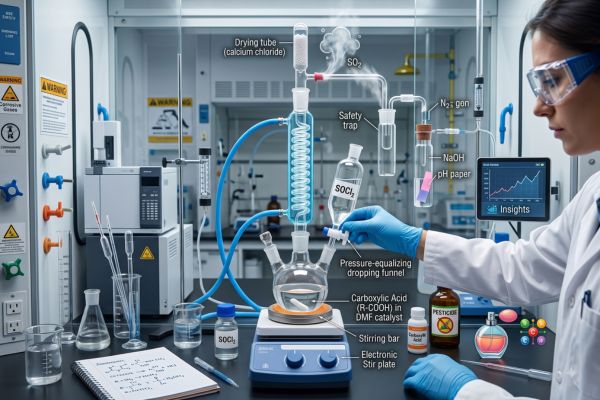
Acid Chlorides Explained Preparation Reactions and Industrial Uses
Acid chloride uses have made these compounds among the most important acylating agents in organic chemistry and industrial synthesis. Acid chlorides (acyl chlorides) are organic compounds with the general structure RCOCl, derived from carboxylic acids through replacement of the hydroxyl group with chlorine. These highly reactive compounds are essential intermediates for creating pharmaceuticals, agrochemicals, polymers, and dyes.
Understanding acid chloride uses is crucial for chemists and chemical manufacturers seeking efficient synthesis routes. Acid chlorides participate in rapid reactions with nucleophiles, making them preferred over other acylating agents in many applications. The exceptional reactivity stems from the highly polarized carbonyl carbon and easily displaced chloride leaving group.
This comprehensive guide explains acid chloride preparation methods, important reactions, and industrial applications. Learn how leading chemical manufacturers in Ahmedabad and Gujarat leverage acid chlorides for producing high-value products efficiently and cost-effectively.
What Are Acid Chlorides and Why Are They So Reactive
Acid chlorides are organic compounds derived from carboxylic acids by replacing the hydroxyl group (-OH) with a chlorine atom (-Cl). The resulting RCOCl structure contains a highly reactive carbonyl carbon. This carbon is extremely polarized, making it highly susceptible to nucleophilic attack. The chlorine atom serves as an excellent leaving group, facilitating substitution reactions. When nucleophiles approach the carbonyl carbon, the chloride ion readily leaves, creating space for new bonds. This combination makes acid chlorides the most reactive acylating agents available. Acid chlorides are more reactive than amides, esters, anhydrides, and carboxylic acids. This increased reactivity allows faster reactions with nucleophiles and enables synthesis of compounds that resist formation with less reactive reagents. The high reactivity makes acid chlorides preferred for many industrial applications.
Acid Chloride Reactivity Comparison
| Acylating Agent | Reactivity Level | Reaction Speed | Common Uses |
|---|---|---|---|
| Acid Chloride | Very High | Fast (minutes) | Industrial synthesis, pharmaceuticals |
| Anhydride | High | Moderate (hours) | Acylation of amines, alcohols |
| Ester | Low | Slow (days) | Natural products, food industry |
| Carboxylic Acid | Very Low | Very Slow | Esterification with catalysts |
| Amide | Very Low | Extremely Slow | Stable functional groups |
Problem: Inefficient Synthesis Without Proper Acylating Agents
Many chemical manufacturers face synthesis challenges when selecting the wrong acylating agent. Using carboxylic acids directly requires strong catalysts, high temperatures, and long reaction times. Yields suffer from equilibrium limitations and side reactions. Expensive catalysts increase production costs. Amide and ester formation using low-reactivity acylating agents produce slow reactions requiring heating and special conditions. Long reaction times increase solvent usage and energy consumption. Extended heating promotes side reactions creating impurities that require expensive purification. Without efficient acid chloride use, manufacturers cannot meet production deadlines or cost targets. Competitors using optimized acid chloride synthesis achieve faster turnaround and lower costs, creating competitive disadvantage.
Solution: Optimal Use of Acid Chlorides in Synthesis
The solution involves understanding acid chloride preparation methods and optimal reaction conditions. Properly prepared acid chlorides enable rapid synthesis at room temperature with minimal side reactions. This reduces solvent usage, energy consumption, and purification costs. Effective acid chloride synthesis starts with carboxylic acid selection. Pure, dry reagents produce better yields. Temperature control during preparation prevents side reactions. Proper acid chloride storage under anhydrous conditions maintains reactivity and purity. Optimizing nucleophile selection, stoichiometry, and reaction conditions maximizes yields. Using appropriate solvents and controlling reaction temperature prevents decomposition.
Best Practices:
- Start with pure, dry carboxylic acids for consistent results
- Use excess reagent slightly to ensure complete conversion
- Control temperature carefully during preparation
- Store prepared acid chlorides under inert atmosphere
- Use dry solvents and glassware for reactions
- Add nucleophiles slowly for better control
- Maintain stoichiometric ratios for optimal yields
- Monitor reaction completion using appropriate analytical methods
Acid Chloride Preparation Methods Compared
Three primary methods exist for preparing acid chlorides from carboxylic acids. The thionyl chloride method is most common due to cost and accessibility. Phosphorus pentachloride offers an alternative for special applications. The oxalyl chloride method is preferred when gentle conditions are needed.
Acid Chloride Preparation Methods Comparison
| Method | Reagent | Byproducts | Best For | Cost Level |
|---|---|---|---|---|
| Thionyl Chloride | SOCl2 | SO2, HCl | General synthesis | Low |
| Phosphorus Pentachloride | PCl5 | POCl3, HCl | Special cases | Medium |
| Oxalyl Chloride | (COCl)2 | CO, CO2 | Sensitive compounds | Medium |
| Phosphorus Tribromide | PBr3 | HBr, phosphorus byproducts | Special cases | High |
| Catalyst with Acid | Acid catalyst | Water | Green chemistry | Variable |
- Thionyl chloride: Most economical, gaseous byproducts
- Phosphorus pentachloride: Vigorous reaction, complete conversion
- Oxalyl chloride: Milder conditions, minimal side reactions
- Phosphorus tribromide: Alternative for bromide synthesis
- Catalytic methods: Emerging greener synthesis routes
Important Acid Chloride Reactions and Transformations
Acid chlorides participate in numerous important reactions due to their high reactivity. Acylation is the primary reaction type where the acyl group transfers to nucleophiles. This creates amides, esters, thioesters, and other acylated products. Friedel-Crafts acylation enables aromatic compound synthesis. Lewis acid catalysts facilitate reaction with aromatic rings. Hydrolysis converts acid chlorides back to carboxylic acids if water is present. Reduction transforms acid chlorides to aldehydes or alcohols. Understanding reaction mechanisms helps predict outcomes and optimize conditions.
Major Acid Chloride Reaction Types
| Reaction | Nucleophile | Product | Conditions | Application |
|---|---|---|---|---|
| Acylation | Amine | Amide | Room temp, base | Drugs, polymers |
| Acylation | Alcohol | Ester | Room temp, base | Esters, cosmetics |
| Acylation | Thiol | Thioester | Room temp, base | Protein chemistry |
| Friedel-Crafts | Aromatic ring | Aryl ketone | Lewis acid | Dyes, intermediates |
| Hydrolysis | Water | Carboxylic acid | Water, heat | Acid recovery |
| Reduction | LiAlH4 or DIBAL | Aldehyde / Alcohol | Low temp | Selective synthesis |
Industrial Applications of Acid Chlorides
Acid chloride uses span the entire chemical manufacturing industry. Pharmaceutical companies use acid chlorides for synthesizing active pharmaceutical ingredients. The rapid reactions enable efficient large-scale production of medications. Agrochemical manufacturers use acid chlorides for creating pesticides, herbicides, and fungicides. Polymer chemists use acid chlorides for producing polyesters, polyamides, and polyurethanes. Dye manufacturers create synthetic colorants using acid chloride chemistry. Fine chemical companies use acid chlorides for custom synthesis of specialized products.
Acid Chloride Uses by Industry
| Industry | Application | Specific Products | Production Scale |
|---|---|---|---|
| Pharmaceutical | Drug synthesis | Antibiotics, antihistamines, pain relievers | Large-scale |
| Agrochemical | Crop protection | Pesticides, herbicides, fungicides | Large-scale |
| Polymer | Chain extension | Polyesters, polyamides, polyurethanes | Very large |
| Dye & Pigment | Colorant synthesis | Reactive dyes, azo dyes, pigments | Large-scale |
| Fine Chemical | Custom synthesis | Specialty compounds, research chemicals | Small-scale |
| Cosmetic | Product ingredients | Fragrances, preservatives, UV absorbers | Medium-scale |
Safety and Proper Handling of Acid Chlorides
Acid chlorides are hazardous chemicals requiring careful handling. These corrosive compounds react violently with water, producing heat and hydrogen chloride gas. Never allow contact with skin or eyes. Proper storage in sealed containers away from moisture is essential. Maintain cool, dry storage conditions. Never mix acid chlorides with bases, water, or incompatible chemicals. Work only in fume hoods with appropriate ventilation. Regulatory compliance and safety training are mandatory for anyone handling acid chlorides.
Safety Checklist:
- Always wear safety goggles and chemical-resistant gloves
- Work only under fume hoods with good ventilation
- Keep water and moisture completely away from acid chlorides
- Store in sealed containers in cool, dry locations
- Never mix with bases, water, or incompatible chemicals
- Have emergency eyewash and safety shower readily available
- Know proper spill cleanup procedures before handling
- Report all accidents and near-misses immediately
Frequently Asked Questions (FAQ)
What is the difference between acid chlorides and anhydrides?
Acid chlorides (RCOCl) are more reactive than anhydrides ((RCO)2O). Acid chlorides react rapidly at room temperature with nucleophiles without catalysts. Anhydrides typically require heating or catalysts. Acid chlorides have lower boiling points and higher reactivity. Anhydrides are more stable during storage. For rapid synthesis requiring high efficiency, acid chlorides are preferred.
How do I choose between thionyl chloride and oxalyl chloride for preparation?
Choose thionyl chloride (SOCl2) for general synthesis due to cost and simplicity. Use oxalyl chloride ((COCl)2) when dealing with heat-sensitive compounds or when milder conditions are required. Oxalyl chloride generates less heat and produces only gaseous byproducts (CO, CO2). For sensitive substrates, oxalyl chloride provides better selectivity and fewer side reactions.
Why is water so problematic with acid chlorides?
Water reacts rapidly with acid chlorides through hydrolysis, converting them back to carboxylic acids and producing hydrogen chloride gas. Even trace moisture (parts per million) causes significant acid chloride loss. This hydrolysis reaction is exothermic and generates heat. Complete loss of acid chloride material reduces yields and wastes resources. Rigorous drying of all reagents and glassware is essential.
What is the most efficient acid chloride for large-scale synthesis?
Acid chlorides prepared from thionyl chloride are most efficient for large-scale production due to lower cost and established industrial processes. The gaseous byproducts (SO2, HCl) are easily separated and can be recovered. Industrial processes can handle the gases safely. For maximum efficiency and lowest cost per unit, thionyl chloride preparation is optimal.
Can acid chlorides be used for environmentally friendly synthesis?
Traditional acid chloride chemistry produces hydrogen chloride gas and other byproducts requiring careful handling. Emerging green chemistry approaches are developing more sustainable alternatives. Developing catalytic systems reduce overall stoichiometric requirements. Recovering and recycling byproducts minimizes waste. However, the high reactivity and efficiency of acid chlorides makes them remain valuable even with environmental considerations.
How should I store acid chlorides to maintain reactivity?
Store acid chlorides in sealed, glass containers with inert atmosphere (nitrogen or argon) when possible. Maintain cool temperatures, ideally 2-8°C. Keep away from all sources of moisture, including humidity. Store separately from bases, water, and incompatible chemicals. Check storage conditions regularly and verify seals on containers. Properly stored acid chlorides maintain reactivity for extended periods.