

Fine vs Specialty vs Commodity Chemicals: Key Differences
Home / Fine vs Specialty vs Commodity Chemicals: Key Differences
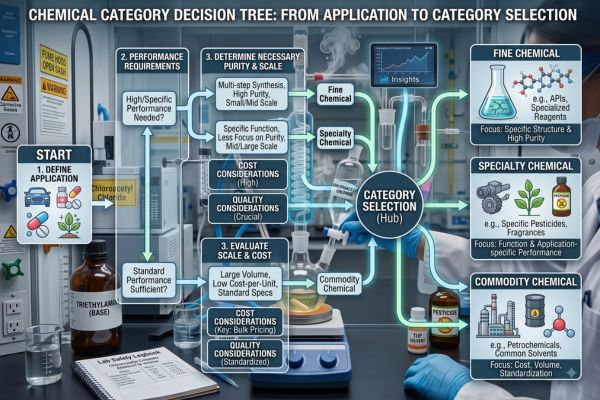
Fine Chemicals vs Specialty Chemicals vs Commodity Chemicals
Fine chemicals vs specialty chemicals vs commodity chemicals represent three distinct categories in the chemical industry. Understanding these categories helps manufacturers make informed decisions about sourcing, production, and cost management. The chemical industry broadly categorizes products into three main groups based on production volume, manufacturing complexity, purity requirements, and pricing structure. Each category serves different purposes and operates under distinct business models.
Fine chemicals are produced in small quantities with complex structures requiring highest purity standards. Specialty chemicals are produced in moderate volumes with specific performance properties. Commodity chemicals are produced in massive volumes using simple, standardized processes. Choosing the right category directly impacts your production costs, timelines, and product quality.
This comprehensive guide explains the differences between fine chemicals vs specialty chemicals vs commodity chemicals. Learn how leading manufacturers in Ahmedabad and Gujarat optimize sourcing decisions for maximum efficiency and profitability in their operations.
Understanding Chemical Categories and Classification Systems
The chemical industry uses classification systems to organize products into categories based on specific characteristics. Understanding these categories helps manufacturers make strategic sourcing decisions. Each category has distinct characteristics regarding production volume, complexity, pricing, and market dynamics.
Commodity chemicals are the foundation of the chemical industry. Specialty chemicals serve mid-market applications. Fine chemicals represent the highest value segment. The classification system enables better strategic planning for chemical manufacturers and consumers.
Chemical Category Overview
| Aspect | Commodity Chemicals | Specialty Chemicals | Fine Chemicals |
|---|---|---|---|
| Annual Production | Millions of tons | Thousands to 100,000 tons | Kilograms to thousands of tons |
| Complexity | Simple structures | Moderate complexity | Complex multi-step synthesis |
| Purity Required | Standard 90-95% | High 95-99% | Very High 99-99.9%+ |
| Price per Kg | Low $1-5 | Moderate $5-50 | High $50-5000+ |
| Production Method | Continuous high-volume | Batch medium-volume | Small batch custom |
Problem: Incorrect Chemical Category Selection Causes Cost and Quality Issues
Many manufacturers face problems from selecting the wrong chemical category for their needs. Using commodity chemicals in applications requiring high purity creates quality failures. Using fine chemicals for bulk production wastes resources on unnecessary purity.
Cost overruns occur when companies fail to match chemical category to actual requirements. Sourcing fine chemicals for commodity-level needs quadruples costs unnecessarily. Conversely, using low-purity commodity chemicals in pharmaceutical synthesis creates batch failures and regulatory problems.
Production inefficiencies result from category mismatch. Excessive purification of commodity chemicals wastes time and resources. Insufficient specification verification of specialty chemicals creates inconsistencies. Regulatory non-compliance occurs when quality standards don’t align with intended use.
Solution: Strategic Chemical Category Selection Based on Application
The solution involves matching chemical categories to actual application requirements. Start by defining exact purity needs for your application. Determine required production volumes and timelines. Calculate total cost of ownership including purification, storage, and waste handling.
Use commodity chemicals for bulk production of simple products where cost is primary concern. Choose specialty chemicals for products requiring specific performance properties or moderate quality standards. Select fine chemicals only when purity and complex structures are truly essential.
Proper supplier evaluation ensures quality matches your requirements.
Best Practices
- Define exact purity specifications needed for your application
- Calculate true cost of ownership including purification steps
- Select suppliers with certifications matching your requirements
- Request certificates of analysis for quality verification
- Start with smaller orders to verify supplier quality consistency
- Build long-term relationships with reliable suppliers
- Monitor incoming material quality through regular testing
- Adjust sourcing strategy based on actual quality and cost data
Commodity Chemicals: High Volume Low Cost Production
Commodity chemicals are produced in very large quantities, measured in millions of tons annually. These chemicals have simple, well-known manufacturing processes that have been standardized over many decades. Examples include sulfuric acid used in numerous industrial processes, ammonia used in fertilizer production, chlorine used for water treatment, and ethylene used as a building block for polymers.
Commodity chemical prices fluctuate based on global supply and demand dynamics. Large scale and efficient manufacturing are essential for profitability. Profit margins are thin due to intense competition among numerous suppliers.
Commodity Chemicals: Key Characteristics
| Characteristic | Detail | Impact |
|---|---|---|
| Volume | Millions of tons per year | High production capacity needed |
| Complexity | Simple molecular structure | Easy manufacturing process |
| Price Volatility | High, follows global trends | Affects budgeting and planning |
| Competition | Many suppliers | Thin profit margins |
| Customization | None, standardized | Limited supplier differentiation |
| Quality | Standard specifications | Acceptable for bulk use |
- Produced in massive volumes for cost efficiency
- Simple manufacturing processes standardized globally
- Prices fluctuate with global supply and demand
- Fierce competition among numerous suppliers
- Thin profit margins requiring high-volume sales
- Used in production of higher-value products
Specialty Chemicals: Targeted Performance and Moderate Production Volumes
Specialty chemicals are produced in moderate to large quantities, ranging from thousands to hundreds of thousands of tons annually. These chemicals have specific performance properties designed for particular applications. Unlike commodity chemicals, specialty chemicals are formulated to provide specific functions in end-use applications.
Specialty chemical manufacturing is more complex than commodity chemistry but less complex than fine chemicals. Specialty chemicals command higher prices than commodity chemicals. The specialty chemical industry is less competitive than commodity markets because each product is tailored for specific applications.
Specialty Chemicals: Applications and Markets
| Application Area | Examples | End Products | Market Demand |
|---|---|---|---|
| Personal Care | Surfactants, preservatives | Shampoos, cosmetics | High growth |
| Construction | Additives, binders | Concrete, coatings | Steady |
| Agriculture | Crop additives, nutrients | Fertilizers, pesticides | High |
| Textiles | Dyes, finishing agents | Colored fabrics | Moderate |
| Electronics | Specialty solvents | Semiconductor production | High growth |
| Automotive | Lubricants, additives | Engine oils, fluids | Stable |
Fine Chemicals: Complex Purity and Specialized Synthesis
Fine chemicals are produced in small to moderate quantities, ranging from kilograms to thousands of tons annually. These high purity compounds are created through sophisticated, multi-step synthesis routes requiring specialized knowledge. Fine chemicals have complex chemical structures demanding rigorous quality control.
The manufacturing processes for fine chemicals are expensive and require significant research and development investment. Batch sizes are typically small compared to commodity and specialty chemicals. Profit margins are high due to premium pricing and specialized applications.
Fine Chemicals: Production and Characteristics
| Characteristic | Commodity | Specialty | Fine Chemicals |
|---|---|---|---|
| Annual Volume | Millions tons | Thousands tons | Kilograms-thousands tons |
| Purity Level | 90-95% | 95-99% | 99-99.9%+ |
| Price per Kg | $1-5 | $5-50 | $50-5000+ |
| Manufacturing | Continuous | Batch (medium) | Batch (small) |
| R&D Intensity | Low | Moderate | Very high |
| Profit Margin | Thin (5-10%) | Moderate (15-25%) | High (40-60%+) |
Cost Analysis: Commodity vs Specialty vs Fine Chemicals
Cost structures differ dramatically across chemical categories. Commodity chemicals cost the least because of high volume production and simple chemistry. The cost per kilogram can be as low as one to five dollars. Specialty chemicals cost more due to moderate volumes and greater complexity, ranging five to fifty dollars per kilogram.
Fine chemicals command the highest prices because of small production volumes, complex synthesis, and stringent quality requirements. Prices for fine chemicals range from fifty dollars to thousands of dollars per kilogram depending on complexity.
For manufacturers in Ahmedabad and Gujarat, understanding these cost dynamics helps in budgeting for raw materials. Selecting the appropriate chemical category directly impacts your profitability and competitiveness.
Chemical Category Cost Compariso
| Factor | Commodity | Specialty | Fine Chemicals |
|---|---|---|---|
| Material Cost | Very Low | Moderate | Variable |
| Processing Cost | Low | Moderate | High |
| Quality Control | Minimal | Standard | Extensive |
| R&D Cost | Minimal | Moderate | Very High |
| Profit Margin % | 5-10% | 15-25% | 40-60% |
| Price per Kg | $1-5 | $5-50 | $50-5000+ |
Selecting the Right Chemical Category for Your Manufacturing Needs
Your choice depends on your specific application and budget constraints. Use commodity chemicals for bulk production of simple products where cost is the primary concern and standard purity is acceptable. Choose specialty chemicals for products requiring specific performance properties or moderate quality standards for enhanced functionality.
Select fine chemicals when purity and complex structures are absolutely essential for your application. Consider supplier reliability and quality assurance capabilities when making your selection. Factor in your production volumes and cost constraints to optimize your sourcing strategy.
Selection Checklist
- Define minimum purity requirements for your application
- Calculate production volumes and timelines
- Determine total cost of ownership including all processing
- Evaluate supplier capabilities and certifications
- Request samples for quality evaluation before large orders
- Verify regulatory compliance for your specific application
- Monitor quality metrics after implementation
- Adjust sourcing strategy based on actual performance data
Frequently Asked Questions (FAQ)
When should I use commodity chemicals instead of specialty or fine chemicals?
Use commodity chemicals when you need high-volume materials for basic applications where standard purity (90-95%) is acceptable. Examples include bulk solvents, basic raw materials, and process chemicals where precise specifications are not critical. Cost is primary consideration. Commodity chemicals work well for manufacturing processes where the final product does not require extreme purity.
What is the price difference between commodity and fine chemicals?
Price differences can be dramatic. Commodity chemicals cost $1-5 per kilogram, while fine chemicals can cost $50-5000+ per kilogram or higher. Specialty chemicals typically cost $5-50 per kilogram. The difference reflects production complexity, purity requirements, and batch sizes. Using fine chemicals for commodity-level needs can increase costs 100-1000 fold unnecessarily.
Can commodity chemicals be upgraded to meet specialty or fine chemical specifications?
Sometimes commodity chemicals can be purified to meet higher specifications, but this adds significant cost through additional processing, purification, and quality testing. Often it is more cost-effective to source the appropriate category directly rather than over-specifying. However, for small-volume needs, purchasing commodity chemicals and purifying them may still be economical.
How do I know which chemical category I need for my pharmaceutical application?
Pharmaceutical applications typically require specialty or fine chemicals with purity above 98%. Verify regulatory requirements from FDA or regional agencies. Consult with your formulation team about specific purity needs. Request certificates of analysis from suppliers. Start with smaller orders to verify quality before committing to large volumes. Most modern pharmaceuticals use fine chemicals for active ingredients.
What production volumes trigger switching from fine to specialty chemicals?
Generally, when annual production volumes exceed 100-1000 kilograms, specialty chemicals become economically viable as they cost significantly less. At 1000+ kilograms annually, specialty chemical sourcing usually becomes the better choice. At millions of tons annually, commodity chemicals dominate. Discuss volume requirements with suppliers to identify optimal category for your production scale.
Are there any environmental or regulatory differences between chemical categories?
Fine and specialty chemicals often have stricter regulatory requirements and certifications (ISO 9001, ISO 14001). Commodity chemicals follow basic safety regulations but less stringent environmental standards. Fine chemicals may require documentation of synthesis purity and testing data. Specialty chemicals typically need compliance certifications. Select suppliers demonstrating commitment to environmental responsibility and regulatory compliance.